
Ongoing conflicts, growing global uncertainty, and threats to critical infrastructure have highlighted the importance of operational preparedness. Disaster recovery for radio broadcasters is essential for maintaining business continuity and ensuring access to reliable information during emergencies.
As part of critical communications infrastructure, radio provides trusted news, public information, and emergency communications, particularly when other communication channels are disrupted.
But how can broadcasting operations continue if the primary broadcasting facility becomes unavailable? Having a disaster recovery environment in place is an essential part of preparing for such situations.
Why Disaster Recovery Matters for Radio Broadcasters
Interruptions to broadcasting operations can occur for various reasons, including:
- Power outages and network failures
- Extreme weather events
- Physical and cyber security threats
- Evacuation of broadcasting facilities
- Damage to physical infrastructure
For commercial broadcasters, interruptions can result in lost advertising revenue and reputational damage. From a broader perspective, they can also limit access to essential information at a time when audiences need it most.
An effective disaster recovery strategy should address both potential system failures and situations where personnel are unable to access their usual broadcasting facilities.
What Is Disaster Recovery in Radio Broadcasting?
Disaster recovery in radio broadcasting involves having the infrastructure, content, and operational capabilities in place to restore broadcasting operations when the primary environment becomes unavailable.
While data backups are an important part of preparedness, they alone do not provide an operational broadcasting environment.
A disaster recovery environment should provide access to essential broadcasting capabilities, including:
- Audio production
- Media assets and programming information
- Scheduling
- Playout
- Distribution
Having an operational recovery environment in place before a disruption occurs allows personnel to focus on restoring broadcasting operations rather than establishing alternative infrastructure during an emergency.
Broadcasting Without Access to the Primary Studio
Traditionally, disaster recovery has relied on maintaining a secondary broadcasting facility with dedicated equipment and infrastructure. While this remains a valid approach, secondary facilities may also be affected by regional disruptions or become inaccessible to personnel.
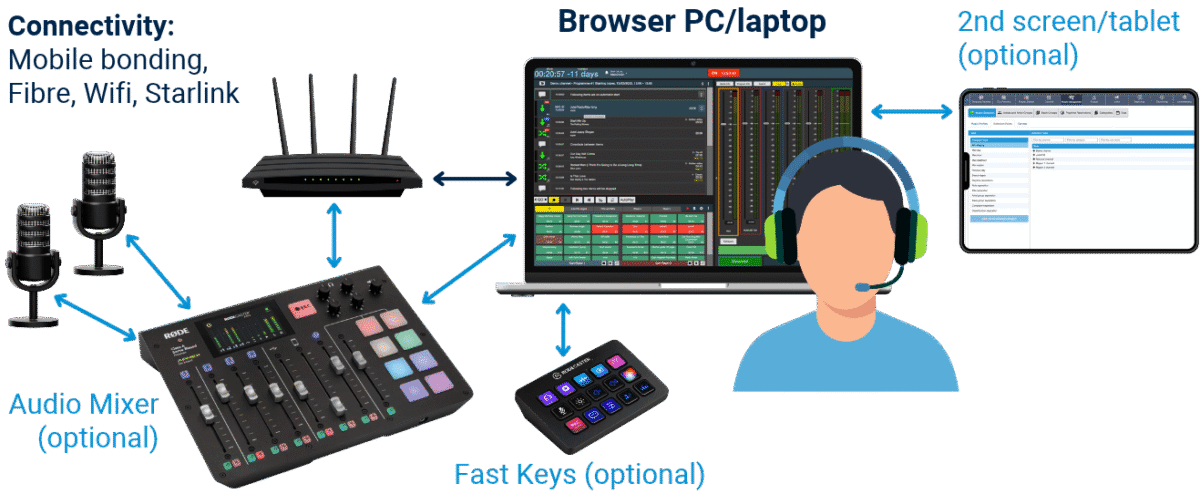
Browser-based broadcasting technology offers greater operational flexibility by reducing dependency on fixed studios and dedicated workstations.
Whether the recovery infrastructure is hosted in the cloud or on-premises, authorized personnel can manage production, scheduling, and playout through a standard web browser from alternative studios, temporary facilities, mobile setups, or individual laptops, wherever suitable connectivity is available.
This location-independent approach also supports the operation of multiple radio channels, which is particularly valuable for larger broadcasting organizations.
Remote audio contribution and production tools further extend these capabilities, allowing journalists, presenters, and production teams to contribute live audio and prepare broadcast content from different locations.
Cloud-Based or On-Premises Disaster Recovery?
Disaster recovery for radio broadcasters can be implemented in the cloud, on-premises, or as a combination of both. The choice depends on your existing infrastructure, security requirements, and operational priorities.
Cloud-Based Disaster Recovery
A cloud-based recovery environment is hosted on third-party cloud infrastructure, providing an alternative broadcasting environment independent of the primary facility. Key benefits:
- Straightforward deployment
- Remote infrastructure management
- No investment in dedicated server hardware
- No physical server maintenance
- Scalability from individual radio stations to multichannel broadcasting networks
- Geographic separation from the primary broadcasting facility
On-Premises Disaster Recovery
An on-premises recovery environment can be deployed at an existing broadcasting facility or at a remote server location, using the broadcaster's own infrastructure. Key benefits:
- Full control over recovery infrastructure and hardware
- Full control over data storage and management
- Ability to utilize existing server and network infrastructure
- Independence from third-party cloud services
- Support for security policies that restrict the use of external cloud services
Combining Cloud and On-Premises Disaster Recovery
Cloud-based and on-premises recovery environments can also be deployed in parallel, with content transfer and synchronization between the two environments. Combining both deployment options provides an additional layer of redundancy and reduces dependency on a single recovery environment.
How to Prepare a Disaster Recovery Strategy
When planning for broadcast continuity, both technical and operational requirements should be considered.
The following questions can help evaluate your current level of preparedness:
- Where would your team operate if the primary broadcasting facility became unavailable?
- How would essential media assets, playlists, and scheduling information remain accessible?
- How would the recovery environment integrate with your existing production systems?
- What alternative connectivity and distribution paths are available?
- How quickly could broadcasting operations be restored?
- Are personnel familiar with the recovery procedures?
- How regularly is the recovery environment tested?
Disaster recovery should be treated as an ongoing operational process rather than a one-time technical implementation.
RadioMan® Disaster Recovery Station
Jutel’s RadioMan® Disaster Recovery Station provides an alternative broadcasting environment with essential production, scheduling, playout, and distribution capabilities.
The recovery system remains operational in the background, with broadcast content already in place. If the primary broadcasting facility becomes unavailable, operations can be transferred to the recovery environment.
For broadcasters using RadioMan®, media assets, playlists, scheduling information, and associated metadata can be replicated at configurable intervals. Integration with other production systems is supported through a content intake plugin, enabling the automatic transfer of audio, music, and text content.
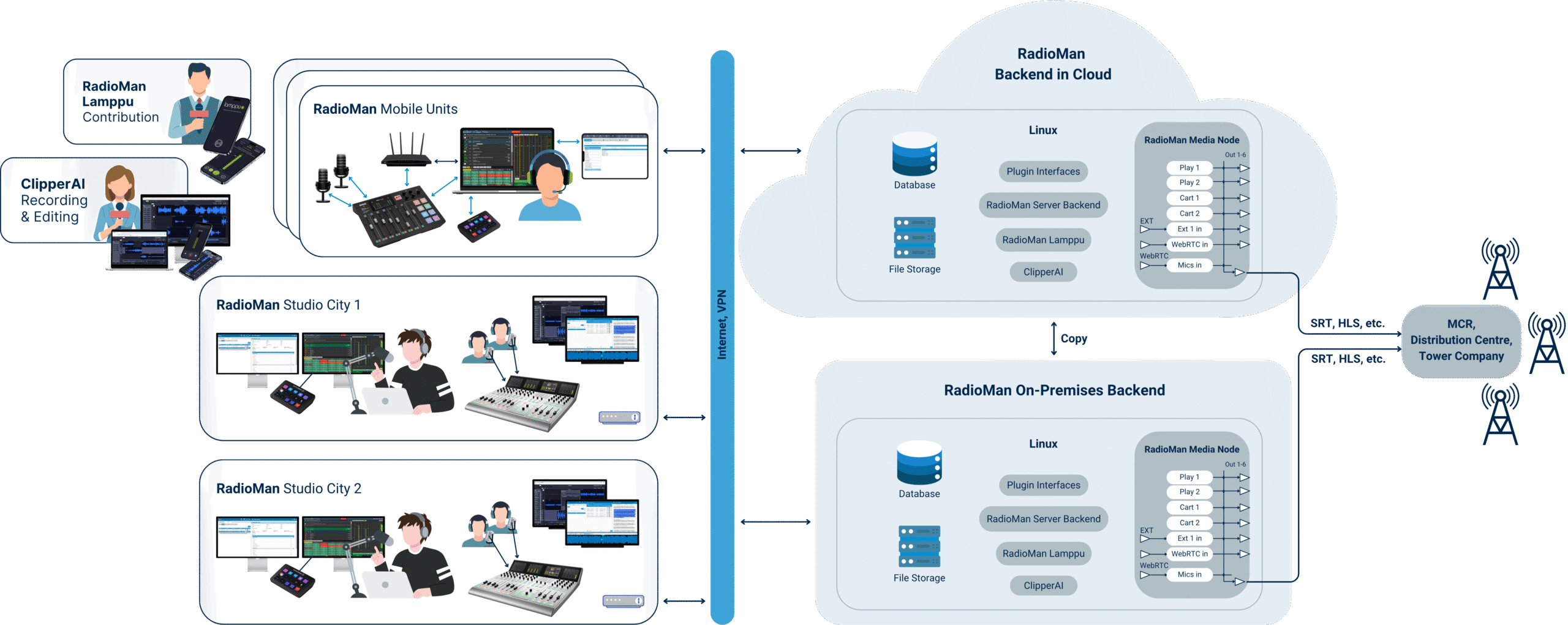
Remote production capabilities can be extended with two additional applications:
- RadioMan® Lamppu for live audio contributions from remote locations using mobile devices or web browsers.
- ClipperAI for remote audio recording, editing, and content production.
Jutel has delivered Disaster Recovery Stations to national broadcasters across Europe, with implementations covering both cloud-based and on-premises environments.
These deployments have given Jutel practical experience in adapting disaster recovery solutions to different broadcasting infrastructures, operational needs, and security requirements.
Let's Talk About Disaster Recovery
Contact us to find the right disaster recovery approach for your broadcasting environment.